見上げる家
計画のはじまりは、「楽しい家をつくりましょう」という一言だった。
楽しいとは何か。広さでも豪華さでもない。
それは、発見があり、想像が動き続ける状態である。そこでこの住宅は、建物としてではなく、乗り物のような存在として構想された。
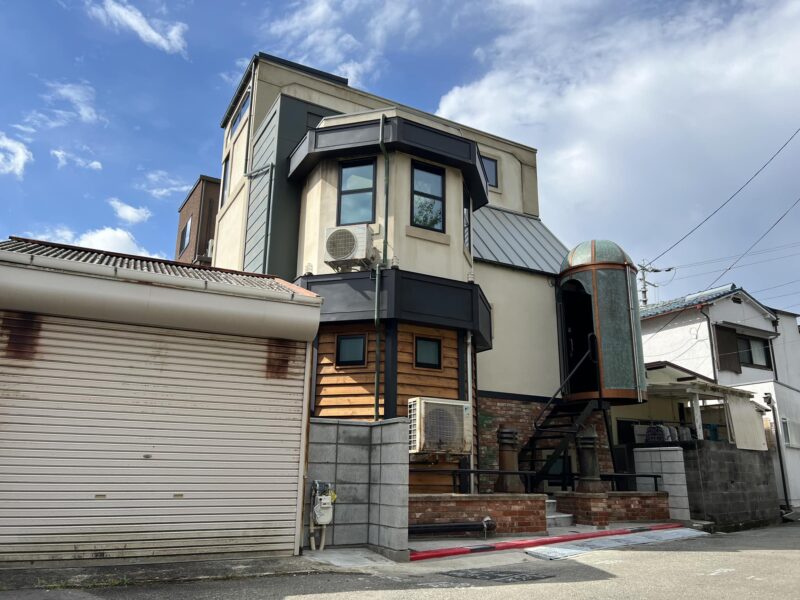
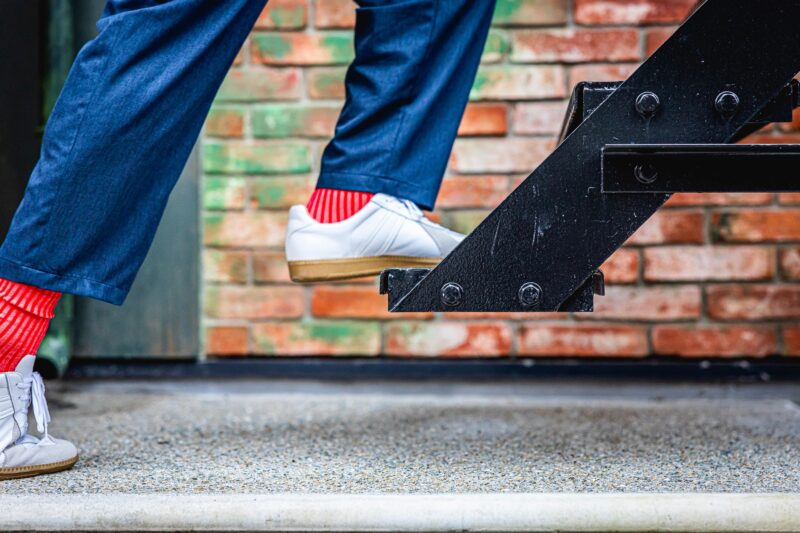
住宅の入口は通常、地盤面に設けられる。しかし「見上げる家」では、一階とも二階とも言えない中間の高さに入口を配置している。
そこへ向かう階段は建物本体からわずかに距離を取り、まるで航空機へ乗り込むためのタラップのような姿として計画された。
住まいに入るのではなく、搭乗する。
その瞬間から、日常とは異なる体験が始まる。
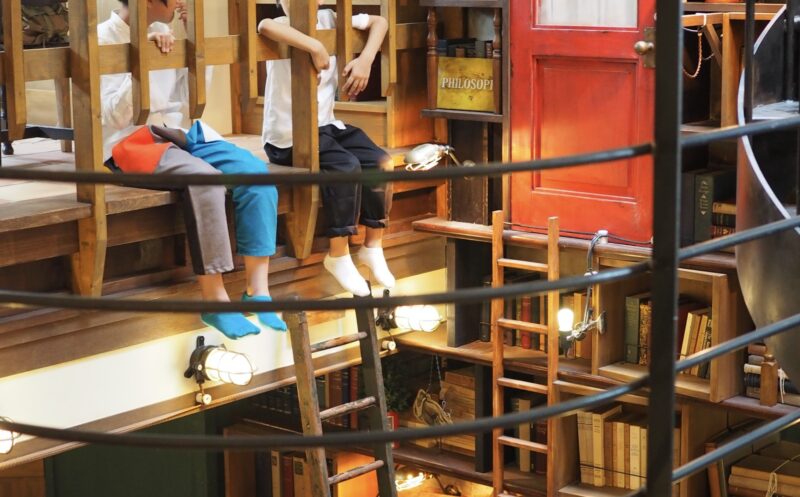
内部空間では、横方向に広げられない敷地条件を逆手に取り、空間を垂直方向へ展開した。三層を貫く吹き抜けと高密度な本棚が、人の身体を自然に見上げる状態へ導いていく。だが、この空間の本質は高さではない。設計の核となっているのは、視線誘導の構成である。
絵画には、必ず視線を集める中心がある。それをフォーカルポイントと呼び、画家は人物の視線や手の向き、構図の流れによって視線がそこへ集まり、画面外へ逃げないよう設計する。「見上げる家」では、この手法を三次元空間に拡張した。
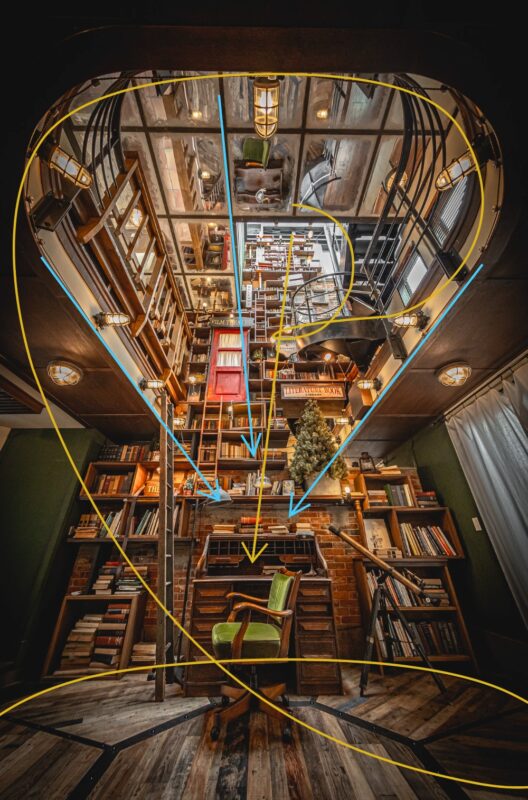
フォーカルポイントとして設定したのは、一階中央に置かれた机である。
この住宅は、無数の本に囲まれながら物語を生み出すファンタジー作家のための家として計画された。だからこそ空間の中心には、人ではなく創作の場を据えた。
そこに本人がいなくても、コツコツと作品をつくり続ける後ろ姿が自然と思い浮かぶ。
空間そのものが、創作の気配を記憶することを目指している。
本棚、床に描かれた円、吹き抜けの手すり、螺旋階段。
あらゆる要素は、この机を中心として広がりながら視線を導くリーディングラインとなっている。
しかし視線を一点に固定すると、空間は安定しすぎてしまう。そこで円弧を描く床や旋回する階段によって、視線は中央から周囲へ流れ、再び上部へ導かれる。吹き抜け頂部へ到達した視線は、光の方向によって再び机へと戻される。
上昇と回帰を繰り返す視線の循環。この構造によって、人は無意識に見上げ続け、空間を眺め続けてしまう。楽しいとは、答えを与えられることではない。
探索したくなること。
想像が動き続けること。
見上げる家は、住宅でありながら、乗り物であり、絵画であり、物語を生成する装置として計画された建築である。
The project began with a simple proposition: to create a house that feels enjoyable to inhabit.
But what does enjoyment mean in domestic space? Not scale, nor luxury, but a condition in which discovery remains possible — where imagination continues to move. From this starting point, the house was conceived less as a building and more as a vehicle for experience.
Rather than placing the entrance at ground level, the threshold is positioned between floors — neither fully first nor second storey. An external stair approaches the volume with a slight detachment, resembling a boarding ramp more than a conventional domestic entry.
One does not simply enter the house. One boards it. From that moment, everyday perception begins to shift.
Within the constraints of a compact site, spatial expansion was pursued vertically rather than horizontally. A triple-height void and densely arranged bookshelves subtly encourage the body to look upward, establishing a physical relationship between movement and perception.
Yet height alone is not the defining element of the project.
At its core lies the choreography of vision.
In painting, attention is organised around a focal point, supported by compositional lines that guide the viewer’s gaze while preventing it from drifting away. House of LOOK UP extends this principle into three-dimensional space.
The focal point is a desk placed at the centre of the ground floor.
Designed for a fantasy writer surrounded by countless books, the house positions the act of creation — rather than its occupant — at the spatial centre. Even in absence, the space suggests presence: the quiet persistence of someone working, imagined rather than seen.
Shelving, circular floor geometry, balustrades and the spiral stair all participate in a system of leading lines that direct attention toward this point.
A single fixed focus, however, risks stability becoming monotony. Curved elements therefore set the gaze in motion. Vision gathers at the centre, rises through the void, and is eventually drawn back downward by light.
An oscillation emerges — ascent and return.
Through this continuous visual cycle, the space resists stillness. Visitors find themselves looking up almost unconsciously, remaining engaged without fully understanding why.
Enjoyment, in this sense, is not something provided.
It arises through exploration — through a space that allows imagination to remain active.
House of LOOK UP was ultimately conceived as a dwelling, a vehicle, and a spatial composition at once: an architecture designed to generate narrative rather than contain it.