えんとつ町のプペル 光る絵本展 in エッフェル塔
本展は、パリ・エッフェル塔の展望空間にて開催された、西野亮廣氏による絵本原画展である。本計画における空間設計は、展示を見るという行為そのものをどのように変化させられるかという問いからはじまった。
エッフェル塔の展望空間は、本来都市を眺めるために設計された場所であり、視線は外部へ向かい遠景へと開かれている。本展ではその方向性を反転させ、都市を見下ろす場所を物語の内部へと意識が向かう環境へ転換することを試みた。
『えんとつ町のプペル』『チックタック〜約束の時計台〜』『ほんやのポンチョ』の原画は、最大6段、高さ約4.5メートルにおよぶ垂直構成で配置された。展示壁は緩やかなカーブを描きながら連続し、奥へ進むにつれて段階的に高さを増していく。この構成は視覚的な演出だけではなく、来場者の身体状態に働きかけるための空間操作でもある。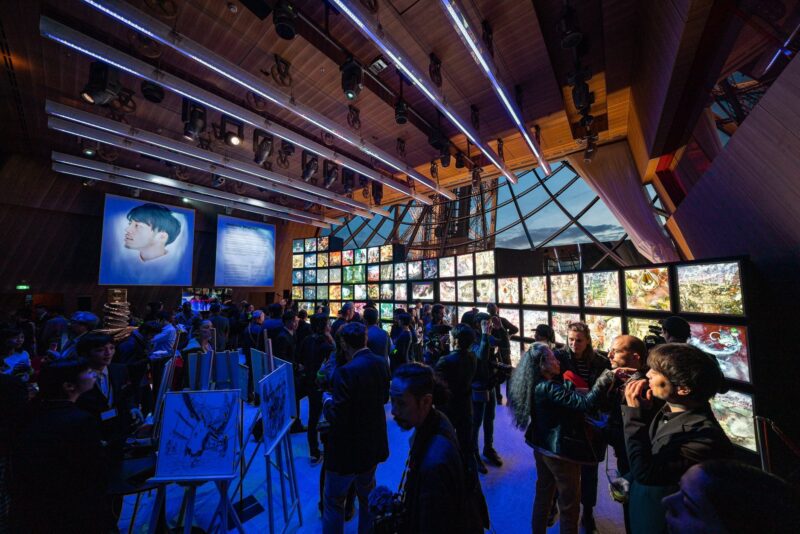
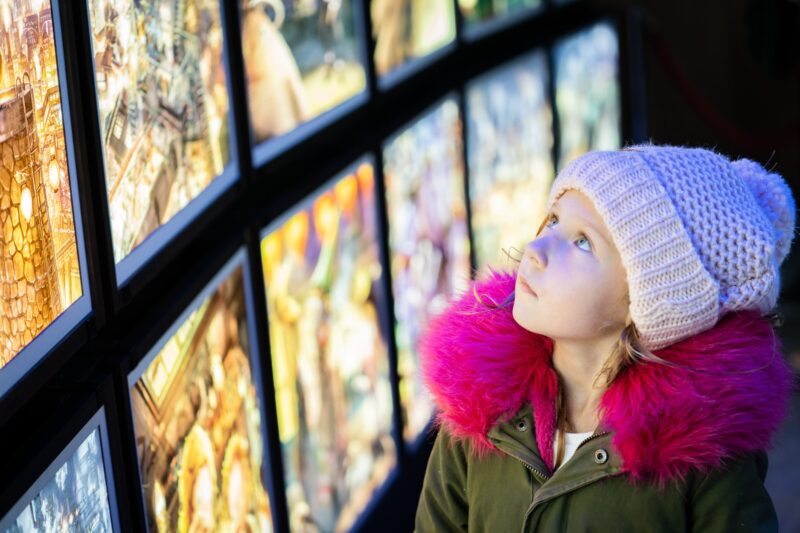
お笑い劇場を数多く巡る中で、西野氏は「よく笑いが起こる劇場ではステージが客席より高い位置にあり、観客が自然に上を向く状態になっている」と述べている。人は上を向くと口角が上がりやすくなり、笑顔になるまでの身体的な負荷が下がる。反対に、視線が下がる環境では感情表現にわずかな抵抗が生まれるという。
この観察は、人の感情が筋肉や姿勢と密接に結びついていることを示している。展示壁が奥へ進むほど高くなる構成は、来場者に見上げる姿勢を無意識に促し、鑑賞体験そのものを心理的変化を伴うプロセスへと変換するためのものである。空間が人に上を向かせることは、結果として感情の開放を促す操作でもある。
また、本展示ではキャプションを設けていない。これは情報を削減するためではなく、言語に依存しない共有体験を成立させるための判断であった。西野氏は、世界へ向けた創作において「言葉は国境をつくるが、表情や映像、身振りといったノンバーバルな表現は国境を越える入口になり得る」と繰り返し語っている。
絵本という媒体が持つ非言語性は、この空間設計における重要な手がかりとなった。異なる母語を持つ来場者であっても、光とイメージを通して同時に物語を共有することができる。世界中の観光客が集まるエッフェル塔という特異な場所において、この条件は極めて象徴的であった。
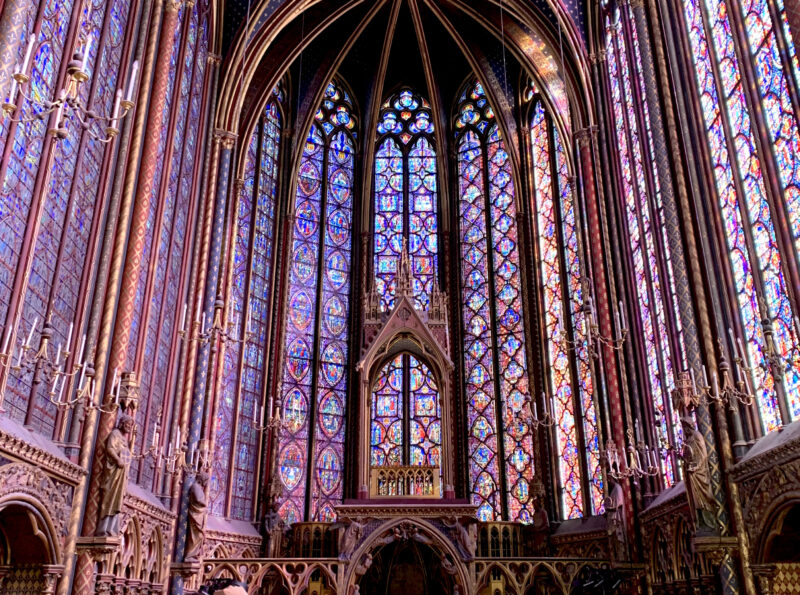
この考え方は、光とイメージを媒介として物語を伝えてきた建築の歴史とも重なる。パリのゴシック建築サント・シャペル聖堂の記憶とも重なっている。
中世ヨーロッパにおいて、多くの人々は文字を読むことができなかった。そのため聖書の物語は、ステンドグラスに描かれた図像と、そこを通過する光によって伝えられていた。ゴシック建築におけるステンドグラスは、物語を理解させるための装置であり、光そのものが語りの媒体として機能していたのである。本計画においてもまた、光とイメージそのものが語り手となる。空間は単なる展示の背景ではなく、物語を共有し伝達する媒体として再解釈されている。
入口では強い光が来場者を迎え、視覚が順応する過程の中で空間が徐々に立ち現れる。展示を見る前に身体が環境へ適応していく時間を生み出すことで、鑑賞は情報理解ではなく経験として成立する。
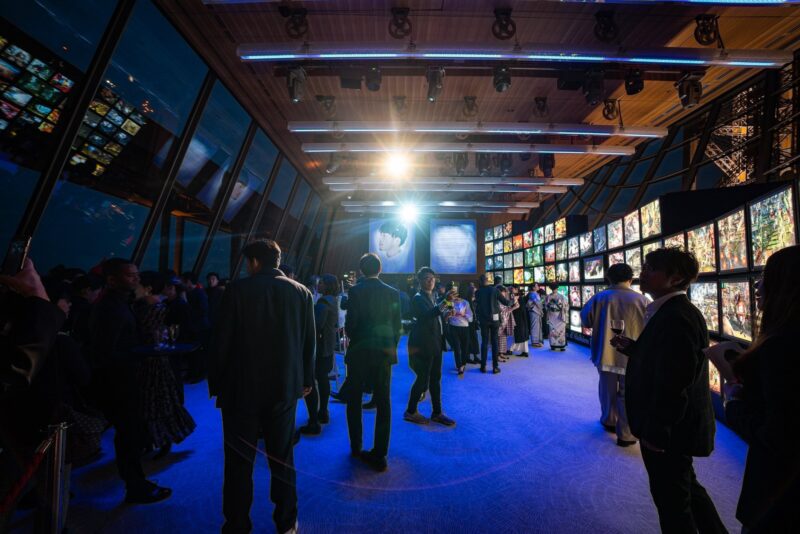
鉄骨構造の隙間から断続的に現れるパリの街並みと、内部を満たす物語の光。そのあいだで来場者の意識は徐々に外部から内部へ移行していく。展望空間は都市を俯瞰する場所から、物語に滞在する場所へと静かに性格を変える。
世界中の人々が集まるこの場所で、言葉を必要としない物語が共有されたこと。それはノンバーバルな創作思想と都市の象徴的空間とが重なり合った、一つの到達点でもあった。
本計画において設計の対象となったのは展示物ではない。
人の視線の向き、身体の動き、そして空間の中で生まれる心理的な転換そのものである。
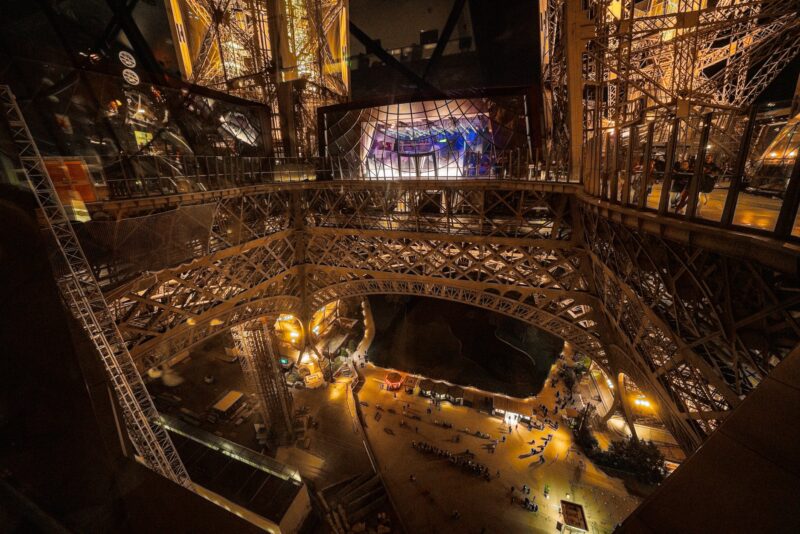
This exhibition, held within the observation level of the Eiffel Tower in Paris, presented original picture book illustrations by Akihiro Nishino through a spatial environment conceived not simply for display, but for transforming the act of viewing itself.
The observation deck of the Eiffel Tower is inherently oriented outward, designed to frame panoramic views of the city. The project sought to gently reverse this condition — shifting attention away from the urban horizon and toward an interior narrative experience. A place intended for overlooking the city was reimagined as a space for entering a story.
Original illustrations from Poupelle of Chimney Town, Tick Tock: The Promise Clock Tower, and Poncho the Bookshop Cat were arranged in a vertical composition rising across six tiers to approximately 4.5 metres in height. Curved display walls unfold gradually through the space, increasing in height as visitors move deeper inside. This progression was not conceived as visual spectacle, but as a spatial device influencing bodily perception.
Through his observations of theatre environments, Nishino has noted that audiences tend to respond more openly in venues where the stage is positioned above eye level. Looking upward subtly relaxes facial muscles, reducing the physical effort required to smile, while downward viewing positions tend to restrain emotional response. Such observations suggest that emotional states are closely linked to posture and muscular condition.
The rising display structure translates this insight into spatial form. As visitors move forward, their gaze is naturally lifted, encouraging a sequence of pausing, looking upward and moving through the space. Viewing becomes an embodied experience, in which perception gradually shifts alongside physical orientation.
Captions were deliberately omitted. This decision was not an act of reduction but a response to context. Nishino has frequently emphasised that while language often creates borders, non-verbal expression — conveyed through gesture, image and atmosphere — can function as a gateway across cultures. Within a global landmark visited daily by people of diverse linguistic backgrounds, the exhibition was therefore conceived to be understood through light, spatial rhythm and shared sensory experience rather than text.
The inherently non-verbal nature of the picture book medium became central to the spatial strategy. Visitors speaking different languages encounter the narrative simultaneously, not through translation but through perception itself. In this setting, storytelling operates beyond linguistic boundaries.
This approach resonates with architectural precedents in which light served as narrative medium. Gothic interiors such as Sainte-Chapelle communicated biblical stories through stained glass to audiences unable to read written text. Similarly, illumination here assumes the role of storyteller, positioning the spatial environment itself as a communicative device.
Visitors enter through an intensely illuminated threshold before their vision gradually adapts, allowing the interior landscape to emerge. The experience unfolds through sensory adjustment rather than instruction, enabling understanding to arise through presence rather than explanation.
Fragments of Paris intermittently appear through the tower’s iron framework, yet attention progressively shifts inward. The observation deck quietly transitions from a platform for viewing the city into a space for inhabiting narrative.
That a wordless story could be collectively experienced in one of the world’s most visited landmarks suggests more than coincidence. It marks a convergence between a pursuit of borderless storytelling and a globally shared architectural setting.
Ultimately, the project addresses not the presentation of artworks, but the choreography of perception itself — shaping how gaze, movement and emotion are reconfigured through space.
Official Event Film
GALLERY page

YOU MAY ALSO LIKE ...
記事が見つかりません。